
Last updated October 31, 2026
 Wrought iron
 Wood & steel frame
 Farm & ranch
 Sliding driveway gates
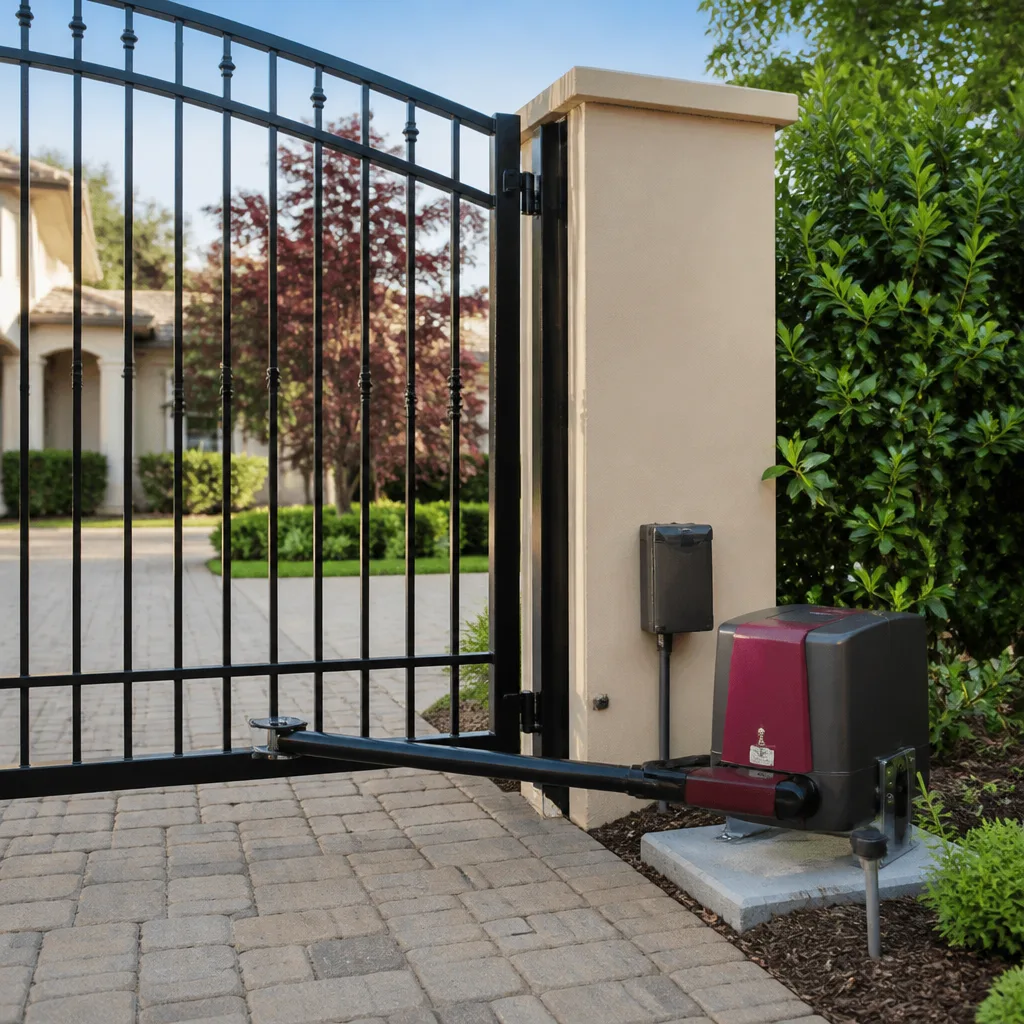 LiftMaster operators
Free on-site gate assessment - hinges, posts, and your LiftMaster or Nice gate operator checked before anything is quoted
The assessment is free and the quote is the invoice.
Get your free estimateHow to Hire a Gate Repair Contractor in Anaheim: A Step-by-Step Guide
Here’s what nobody tells you about hiring a gate contractor in Anaheim: the license hanging on the wall may cover gate work legally, but it tells you nothing about whether that person has ever diagnosed a failing FAAC control board or rewired a LiftMaster loop detector. In California, a C-13 fencing contractor can legally accept gate jobs, and plenty of generalists do exactly that. Meanwhile, your gate sits half-open, your opener hums without moving, and every day it stays broken is another day your property is accessible to anyone who pushes hard enough. This guide walks you through exactly how to filter for genuine gate specialists before anyone opens a toolbox on your Anaheim property, and our Gate Repair services are here when you’re ready to hire.
Quick Answer
To hire a gate repair contractor in Anaheim, verify the license classification on the CSLB portal, ask brand-specific diagnostic questions that only a gate-focused specialist can answer comfortably, demand line-item quotes that name actual parts instead of “gate repair – labor,” and read reviews looking for gate-specific language, not generic praise about friendliness. A genuine gate specialist names the operator brand in your driveway within the first visit and tells you straight whether repair or replacement is the smarter spend, as explained in our Choosing the Right Gate Repair Brand: A Buyer’s Guide for Anaheim.
Styles & brands we work with
Table of Contents
- Understanding California License Classifications for Gate Work
- Questions That Reveal Whether Gates Are a Primary Trade or an Add-On
- Reading a Gate Repair Quote: Line Items, Brand Names, and Labor Warranties
- How to Read Reviews for Gate-Specific Expertise
- What a Legitimate Diagnostic Visit Looks Like
- Repair vs. Replace: When the Honest Answer Is a New Gate
- What Gate Repair Costs in Anaheim: Real Numbers
- Hiring for Commercial and HOA Gate Systems in Anaheim
Understanding California License Classifications for Gate Work
Gate work in California sits in a licensing gray zone that most homeowners never learn about until something goes wrong. The C-13 fencing license covers gates because gates attach to fences structurally. But a C-13 holder may have spent twenty years installing chain-link around warehouses and never once touched an electric gate operator. That same license technically allows them to pull a permit for your automated gate job. The electrical components inside your gate opener are a different animal, and this is where the C-10 electrical license matters.
Here’s the practical breakdown for Anaheim homeowners:
- C-13 Fencing Contractor: Legally covers gate installation and structural gate repair. Says nothing about experience with operators, control boards, sensors, or wiring.
- C-10 Electrical Contractor: Required for the electrical work inside an automated gate system, including motor wiring, loop detectors, and control board replacement. Many C-13 contractors sub this out or ignore the requirement entirely.
- Both licenses together: A contractor holding both has the legal authority to handle structural gate work and the electrical operator systems that make automated gates function. This combination is rarer, and it’s a signal the company took the extra step to stay compliant on both sides of the job.
Verification takes under two minutes on the California Contractors State License Board portal. Enter the license number, confirm it’s active, and check the classification. Then look at the “Workers’ Compensation” status, because a contractor without coverage who gets hurt on your Anaheim property becomes your liability. In our experience, the contractors who hesitate when you ask for their license number are the ones you don’t want touching a system that weighs several hundred pounds and runs on line voltage.
The Anaheim-specific angle matters here. Anaheim has thousands of properties with automated driveway gates, from older Anaheim Colony homes with original swing gates to newer developments in Anaheim Hills with premium operators. The city’s mix of residential and commercial gate work means a contractor could easily survive on fence jobs alone while claiming gate expertise. Your license check is the first filter, but it’s only the first.
Questions That Reveal Whether Gates Are a Primary Trade or an Add-On
The single biggest hiring mistake in Anaheim isn’t skipping the license check. It’s hiring someone whose gate experience is incidental to their main business. Fence companies do fences. Garage door companies do garage doors. Handymen do whatever shows up that morning. All three will tell you they “handle gates too,” because gates are attached to fences, they swing on hinges, and a broken gate looks fixable. But an automated gate blends structural steel, high-cycle hinges, low-voltage control wiring, and line-voltage motors. That’s four trades in one cabinet, and generalists learn the fourth trade on your property.
Ask these questions on the first call. A gate specialist answers without pausing. A generalist hesitates, redirects, or gives you a vague reassurance:
- “Which operator brand is on my gate, and what are the common failure points on that specific model?” A specialist names your brand from the symptoms you describe or asks one clarifying question about the keypad style. If you’re running a LiftMaster, FAAC, BFT, or Linear operator, the answer should come fast.
- “Do you stock parts for my brand, or are you ordering after you diagnose?” Gate specialists carry common boards, sensors, and capacitors for the brands they service regularly. If every part is “special order,” you’re paying for someone else’s learning curve and the shipping time that comes with it.
- “How many gate operators have you diagnosed this month?” A gate-focused contractor answers with a number. A generalist answers with “we do all kinds of things.”
- “Do you handle the electrical side yourself, or does an electrician come separately?” This separates structural gate shops from full-system specialists. The answer you want is some version of “we handle the operator, control board, and wiring in-house.”
- “What’s the most common gate failure you see in Anaheim specifically?” In our market, the answer is usually hinge sag on older swing gates and phantom loop failures on commercial properties. A contractor who works Anaheim neighborhoods knows this. A contractor who “also does gates” gives you a generic answer about “weather.”
One more thing: listen for brand names without prompting. A contractor who says “LiftMaster” or “FAAC” or “BFT” without you feeding them the name has been in front of those operators before. A contractor who says “the motor thing” hasn’t. This is the difference between a technician who has seen your system before and one who is Googling the manual on-site, and it’s the difference between a same-day fix and a two-week parts chase.
Reading a Gate Repair Quote: Line Items, Brand Names, and Labor Warranties
A gate repair quote tells you more about the contractor than any sales pitch ever will. The way a quote is written reveals how the contractor thinks about the work. Vague quotes come from vague processes. Specific quotes come from people who have done the job enough times to know exactly what goes into it.
Red flags in an Anaheim gate repair quote:
- “Gate repair – labor” as the only line item. What does that mean? Which components? Which side of the gate? If the contractor can’t name the part, they haven’t diagnosed the problem.
- No brand names anywhere on the quote. A legitimate quote for a FAAC operator names the FAAC part number or at minimum the part name. “Replacement circuit board” without a brand tells you they don’t know what they’re ordering yet.
- One warranty line covering everything. Parts and labor need separate warranty terms. A control board might carry a 1-year manufacturer warranty while labor carries 30 days. If the quote says “warranty: yes,” that’s not a warranty.
- No mention of diagnostics as a separate line item. Legitimate gate shops charge a diagnostic fee that gets credited toward the repair. A quote that skips diagnostics and jumps straight to “replacement” is a sales quote, not a repair quote.
A legitimate gate repair quote from a specialist looks like this: a diagnostic line item, a named part with brand and model, a labor line item with hours estimated, a safety equipment check (photo eyes, reverse sensors, edge sensors), and two warranty lines, one for the part and one for labor. You’ll also see a note confirming the price is agreed before work starts.
That last point matters more in gate repair than almost any other home service. Gate systems hide problems. A hinge that looks fine from the street might have internal wear that only reveals itself once the gate is off its post. A control board that tests fine on the bench might throw a fault code once it’s reinstalled and talking to the safety sensors. That’s why every reputable gate contractor in Anaheim quotes the job, confirms the number with you, and doesn’t start turning wrenches until you’ve said yes to the specific dollar amount. If a contractor won’t commit to a number before starting, walk away from that quote entirely.
How to Read Reviews for Gate-Specific Expertise
Review platforms are full of five-star ratings attached to comments like “great guys, very friendly.” That tells you the crew was polite. It tells you nothing about whether they fixed the gate correctly or whether it’s still working six months later. Reading reviews for gate work requires looking past the star rating and into the language the reviewer uses.
Here’s what a review from a genuinely knowledgeable customer who worked with a genuine gate specialist sounds like:
- “They diagnosed my LiftMaster operator on the spot and had the control board in the truck.” This reviewer used the brand name. That means the contractor talked in specifics during the visit, and the customer absorbed those specifics.
- “They showed me exactly which sensor was failing and explained why it kept tripping.” This reviewer understood the diagnosis. A contractor who explains the failure point builds customers who can describe it later.
- “They told me the gate wasn’t worth repairing and showed me the math.” This reviewer worked with an honest contractor who recommended replacement over repair when replacement made more sense. That’s the contractor you want, not the one who patches a dying gate to get paid today.
- “Two years later, the gate still opens perfectly every morning.” This reviewer confirmed durability. Gate repair isn’t a one-day transaction. It’s a test of whether the fix lasts through two Anaheim summers and two wet winters.
Now here’s what generic satisfaction looks like:
- “They were on time and very nice.” Fine. Irrelevant. Says nothing about the gate.
- “Great service, would recommend.” Service meaning what? Same-day arrival? The gate works? The coffee they drank?
- “Affordable and fast.” In gate repair, cheap and fast often means the contractor replaced the easiest possible component, not the component that was actually failing. Fast can be a warning sign when it comes with a bill that’s suspiciously low.
When you read reviews for a gate contractor in Anaheim, filter for specificity. Ctrl-F the review page for the words “operator,” “sensor,” “hinge,” “control board,” and any brand name from your gate’s manufacturer list. If those words don’t appear anywhere in the reviews, the contractor’s customers aren’t walking away with any real understanding of what was done, which means the contractor probably didn’t explain it, which probably means the diagnosis was shallow. A gate specialist leaves evidence in the review section: brand names, component names, and explanations that a customer could repeat to another contractor.
What a Legitimate Diagnostic Visit Looks Like
There’s a difference between a diagnostic visit and a sales visit wearing a diagnostic costume. Both start the same way: a contractor shows up at your Anaheim home, looks at your gate, and tells you something. The difference is in what happens next.
A legitimate diagnostic visit follows a pattern you’ll recognize if you know what to watch for:
- The contractor asks you to operate the gate first. They want to see the failure happen in real time. They listen to the motor, watch the gate’s movement, and check whether the problem happens consistently or intermittently. A contractor who skips straight to “I know what’s wrong” before watching the gate move is diagnosing from a script.
- They open the operator housing. The cover comes off, and they look at the control board, the wiring, the capacitor, and the limit switches. They may pull out a multimeter to check voltage at the board. This is normal and expected. A contractor who never opens the housing and instead describes the problem from outside is guessing.
- They check the safety sensors as part of the diagnosis, not as an upsell. Photo eyes, edge sensors, reverse sensors, and loop detectors all fail independently of the motor. A real diagnostic includes verifying these, because a gate that works but doesn’t reverse when a child is in the path is more dangerous than a gate that doesn’t work at all.
- They check the physical structure. Hinges, wheels, the gate post, the track if it’s a slide gate, structural welds. Gate failures are often mechanical stress showing up as electrical symptoms. A sagging hinge makes the motor work harder, which blows capacitors. The specialist traces the problem back to the source.
- They give you a diagnosis with a specific part name and a price commitment before any repair work starts. Not “your gate has issues.” Not “this thing’s old.” They hand you a number for a named part, a labor estimate, and they ask permission to proceed. That’s the diagnostic visit done right.
An Ironcrest Gate Repair home diagnostic visit is built around one goal: telling you exactly what’s wrong, what it costs, and whether it’s worth fixing. Sometimes the answer is genuinely “this gate has five more years in it.” Sometimes it’s “this gate is done, and here’s the replacement number.” Either way, you leave the visit knowing more about your gate than you did when the contractor arrived.
Repair vs. Replace: When the Honest Answer Is a New Gate
No gate contractor should be selling you a new gate every time a capacitor fails. But no honest gate contractor patches a system that’s past its useful life. The skill is knowing which situation you’re in, and being straight about it.
Here’s the threshold question we use in our own work: is the repair cost more than 50% of the replacement cost, and is the gate over 10 years old in Anaheim’s climate? Anaheim’s dry summers are kind to metal, but the coastal moisture that rolls in during winter mornings accelerates corrosion on hinges, operators, and exposed wiring over a decade of cycles—see our Seasonal Gate Repair Care for Anaheim: Year-Round Homeowner’s Guide for maintenance tips. Gates that run 20-40 cycles per day are the norm in Anaheim neighborhoods full of daily commuters. That’s 7,300 to 14,600 cycles per year. Over 10 years, that’s over 100,000 cycles on the operator, hinges, and track. Most residential operators are rated for 10,000 to 50,000 cycles. The math catches up.
When replacement makes more sense than repair:
- The operator is over 15 years old and the control board is discontinued. You’re one eBay purchase away from a system you can’t maintain. New operators from LiftMaster, Linear, or FAAC come with current part availability and safety features the old system never had.
- The gate itself is structurally compromised. Cracked welds, rusted-through posts, a gate that’s sagged beyond hinge adjustment. You’re not repairing that. You’re buying time in small installments.
- The safety systems are obsolete or non-functional. Older gates may lack modern safety edges, photo eyes, or reverse mechanisms. Some parts simply can’t be retrofitted onto ancient systems. In Anaheim, where many homes date to the 1950s and 1960s, this is a common scenario.
- The repair cost exceeds half the replacement cost, and the gate is over 10 years old. That’s the threshold. Repairing past this point is spending new-gate money to keep an old gate alive.
When repair clearly wins:
- The operator is under 8 years old and the failure is a single component. A capacitor, a sensor, a limit switch. Replace the part, keep the gate.
- The structure is sound and the gate’s cycle count is low. A gate that opens twice per day is fine at 12 years old. A gate that opens 40 times per day is not.
- The repair is under $400, and the gate has years of structural life left. That’s not a “maybe” scenario. That’s a fix.
A gate specialist tells you the truth in either direction. A generalist tells you what’s easiest to bill. If you’re in Orange County and need a straight answer on repair versus replace, a shop that does Gate Installation in Brea work understands both sides of the equation, because they’re not forced to sell one service to survive.
What Gate Repair Costs in Anaheim: Real Numbers
Gate repair pricing in Anaheim follows patterns you can predict if you know what you’re looking at. Here’s what real money looks like in this market, based on the work we see day in and day out across Orange County:
- Diagnostic visit: $75 – $150, credited toward the repair if you proceed. A legitimate shop charges for the diagnostic because the diagnostic is real work. A free diagnostic is usually a sales call.
- Capacitor replacement: $150 – $300. The part is cheap. The labor is the diagnosis plus the swap plus retesting the gate’s full cycle.
- Safety sensor (photo eye or edge sensor) replacement: $200 – $450 per sensor. This includes the part, alignment, and testing that the gate reverses properly under obstruction.
- Hinge replacement (swing gate): $300 – $700 per hinge depending on gate weight, hinge type, and whether the gate post needs reinforcement.
- Control board replacement: $400 – $900 depending on the operator brand. LiftMaster and Linear boards sit at the lower end. FAAC and BFT boards run higher, driven by part cost and the diagnostic precision required.
- Full operator replacement (motor and control assembly): $1,200 – $2,800 installed for residential systems, depending on brand and duty cycle rating. Commercial operators from FAAC, BFT, and DoorKing start higher and go up with cycle ratings and access control integration.
- Loop detector replacement: $350 – $800, including cutting the loop, trenching, sealing, and testing sensitivity settings.
These numbers assume a gate specialist doing the work. Generalists often quote lower because they’re replacing fewer components and not testing the safety systems. You pay less today, and the same gate fails again in four months. That’s not a lower price. That’s a higher price paid twice.
Every price on every job should be quoted and agreed before work starts. No surprises, no “we found another issue” upcharges that weren’t discussed. A written quote with part names, labor hours, and the total number is the minimum standard. If you’re getting oral estimates for gate repair in Anaheim, you’re dealing with someone who doesn’t want a paper trail.
Hiring for Commercial and HOA Gate Systems in Anaheim
Commercial gates in Anaheim are a different hiring decision than residential gates. The stakes are higher, the cycle counts are brutal, and the access control systems are more complex than a keypad and a remote. HOA managers and commercial property owners in Anaheim also face a different pressure: a broken gate doesn’t just annoy one household, it creates a service queue of angry residents or tenants before lunch.
Here’s what changes when you’re hiring for a commercial or HOA gate system:
- Cycle count becomes the dominant factor. A residential gate cycles 20-40 times per day. A commercial gate in Anaheim’s industrial districts or a busy HOA entrance cycles hundreds of times daily. That’s why commercial operators are rated differently, built differently, and cost differently. The contractor you hire needs to understand cycle ratings, not just “gates.”
- Access control integration becomes non-negotiable. Keypads, card readers, telephone entry systems, vehicle detection loops, and sometimes license plate cameras all need to talk to the gate operator. A contractor who only understands the mechanical side of gates will stall on the integration side.
- Downtime costs real money or real frustration. A distribution center’s gate down means trucks waiting. An HOA gate down means residents calling the management office every hour. Professional gate contractors make commercial calls a priority because they understand the cost of a gate that doesn’t open.
- Brand range matters more. Commercial operators come from FAAC, BFT, DoorKing, and commercial-grade LiftMaster lines. The contractor needs to know these operators specifically, not generally.
Commercial gate repair in Anaheim is where the specialist-vs-generalist divide gets widest. A fence company can hang a commercial gate. Very few fence companies can diagnose a FAAC hydraulic operator that’s throwing a fault code. Very few garage door companies can integrate a DoorKing telephone entry system with a new loop detector. The contractor who can do all of it is a gate specialist by definition, not by marketing. For commercial clients, Electric Gate Repair in Brea work showcases the kind of full-system capability that Anaheim commercial properties need: operators, control boards, loop detectors, keypads, and the integration layer that ties them together.
Common Mistakes to Avoid
- Hiring a fence contractor to diagnose an electric gate operator. They’re licensed for gates. They’re not necessarily experienced with operators. Confirm brand-specific experience before signing anything.
- Skipping the safety sensor question entirely. A gate that opens but doesn’t reverse on obstruction is dangerous. Ask about safety systems during the diagnostic. If the contractor can’t explain how your gate’s reverse mechanism works, that’s a red flag.
- Accepting a quote with no part names. “Gate repair” is not a line item. If the quote doesn’t name the parts, the contractor hasn’t identified the problem.
- Paying in full before the gate is working. Deposits on special-order parts are normal. Full payment up front for a “future repair” is not. Gate repair in Anaheim operates on the standard of work completed, then payment.
- Choosing the lowest quote without comparing line items. A lower quote often means fewer parts replaced and fewer tests performed. Compare exactly what you’re getting, not just the bottom number.
- Ignoring the gate’s physical condition while fixing the operator. A new motor on a sagging gate is a motor that dies young. The structure and the operator are one system.
- Not asking who handles the electrical side. If the answer involves a separate electrician, get that electrician’s name and license before the job starts. Unlicensed electrical work on a gate operator creates liability for the property owner.
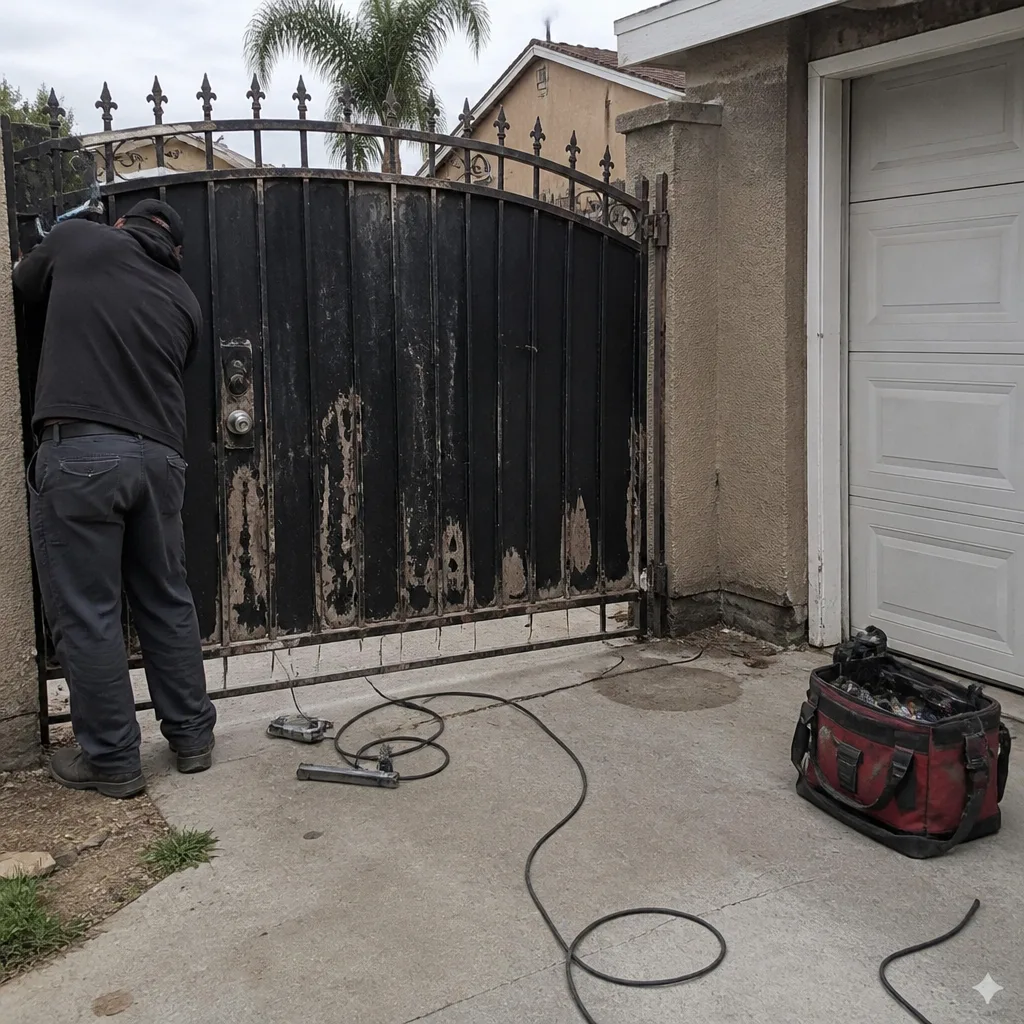
See the difference
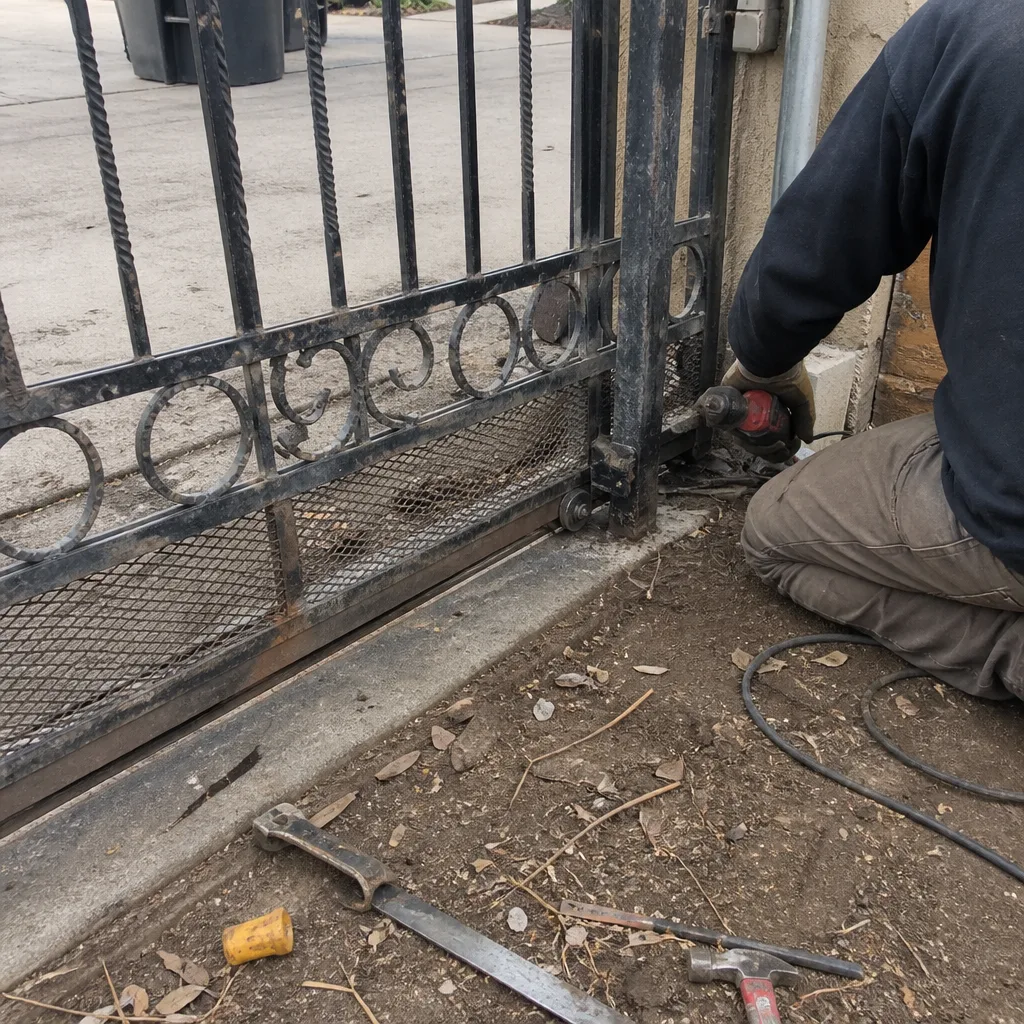 Before
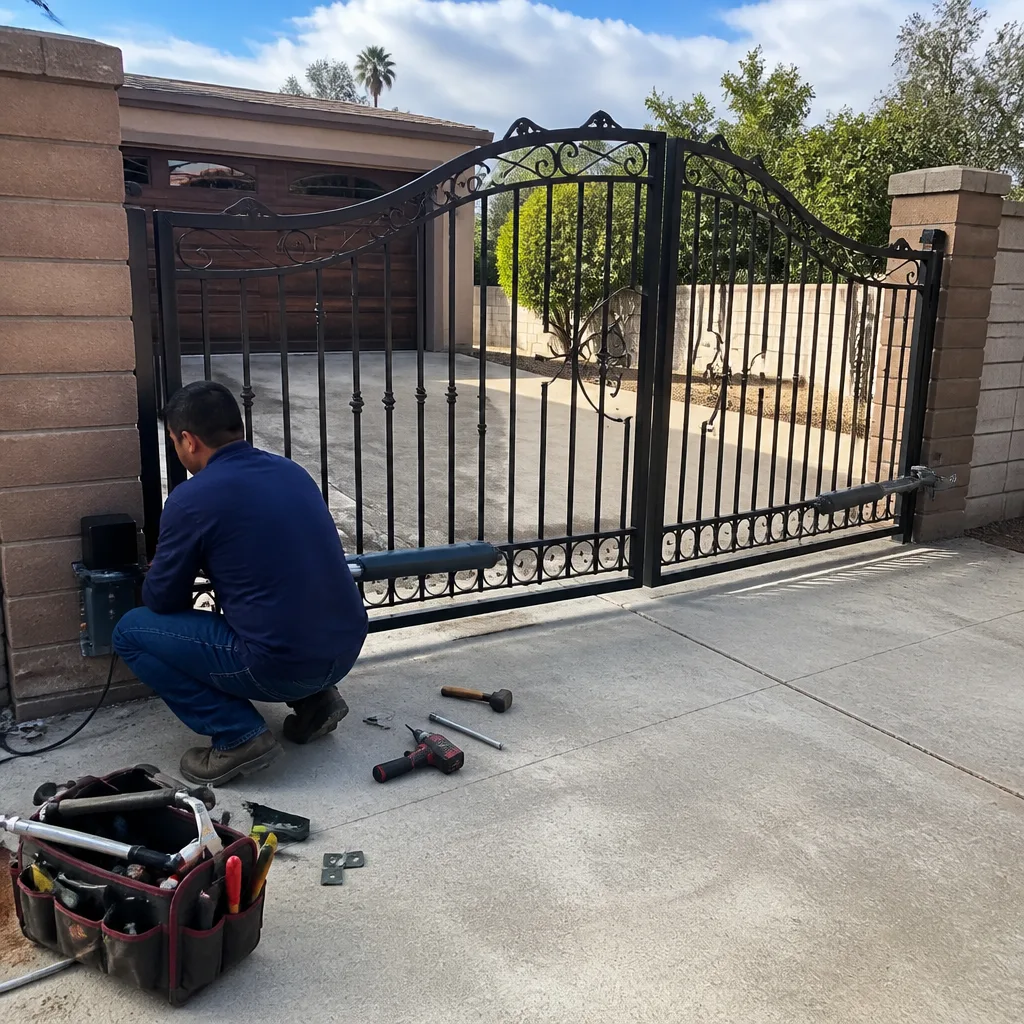 After
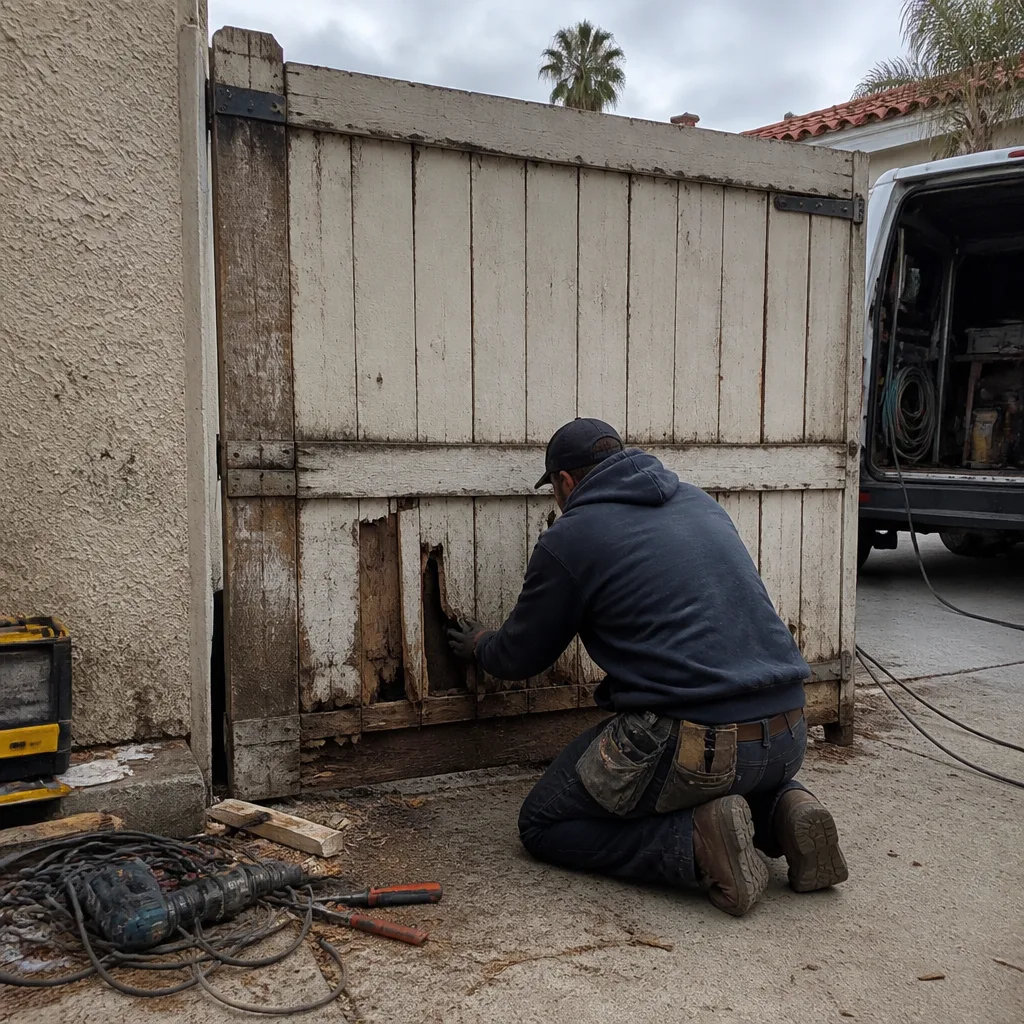 Before
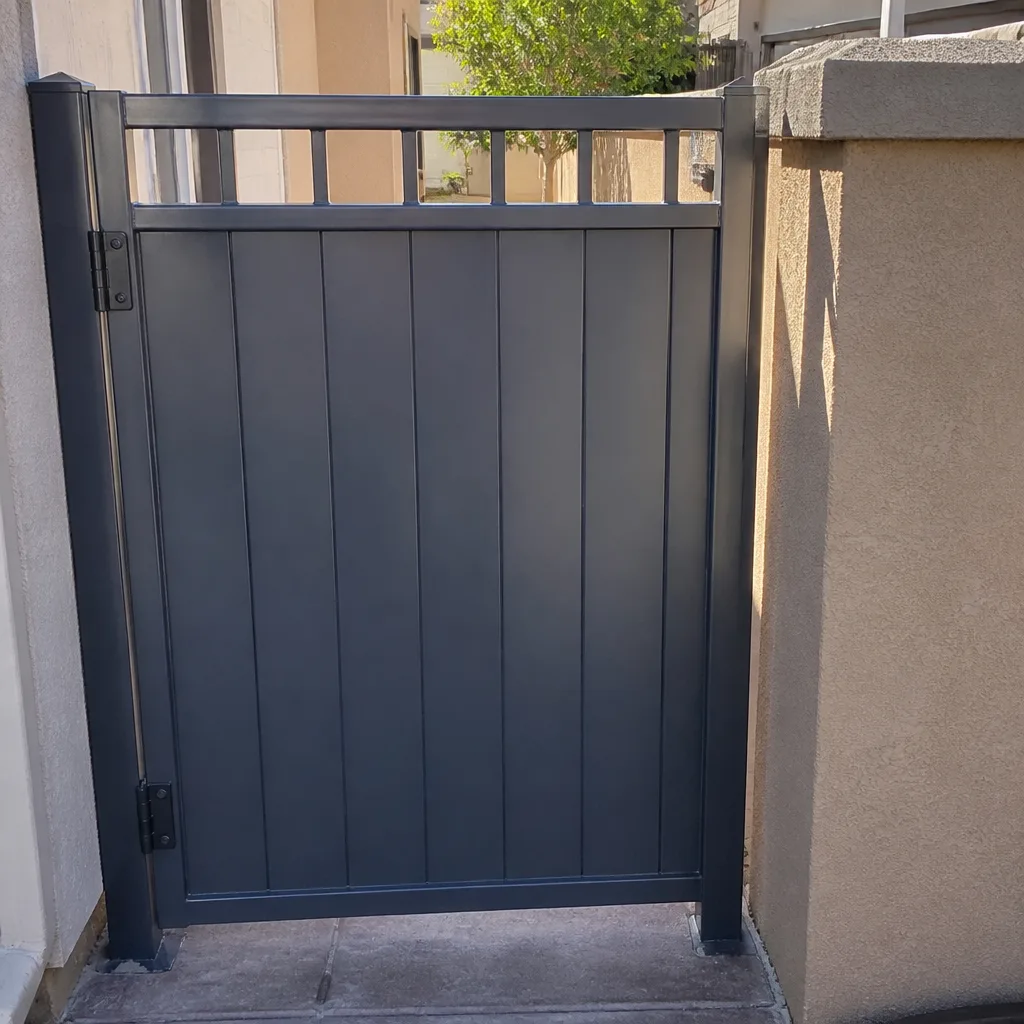 After
 Before
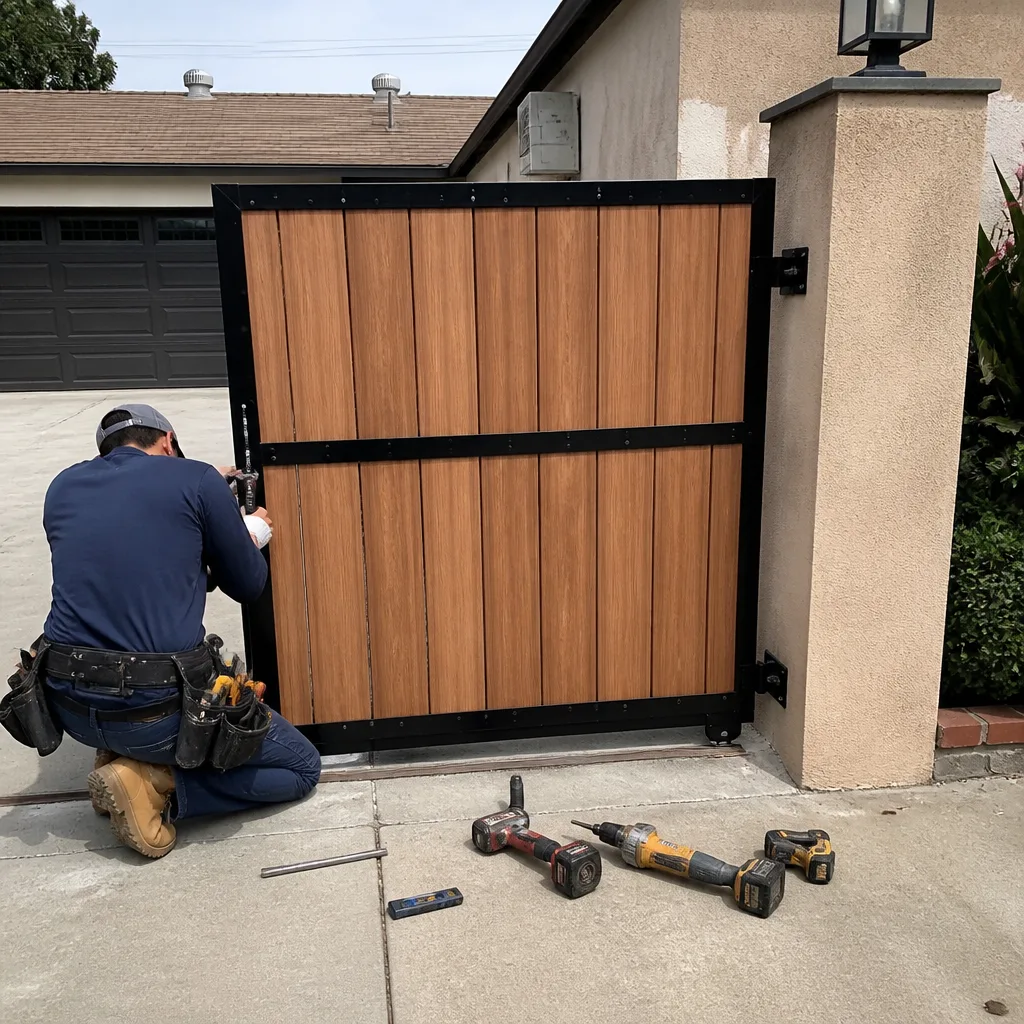 After
When to Call a Professional
Gate systems involve multiple hazards: heavy moving steel, high-tension springs, line-voltage wiring, and pinch points that can injure fingers, hands, or worse. If your gate is off its track, if the operator is sparking or humming without moving, if safety sensors are bypassed or non-responsive, or if the gate slams instead of closing softly, those are professional-grade problems. High-tension springs under compression can release catastrophically. Live electrical components inside an operator can shock. A gate that falls off its post can crush. Don’t diagnose line-voltage wiring or high-tension springs yourself. Ironcrest Gate Repair offers free estimates in Anaheim, call (833) 589-7839 and a gate specialist will come out, diagnose the system, and give you a written number before any work starts. Gate Repair in Brea clients get the same straight answer: the estimate is free, the diagnosis is real, and the price is set before we touch a single tool.
Frequently Asked Questions
Go to the Contractors State License Board website, enter the contractor’s license number, and check that the license is active, the classification covers gate work (C-13 for structural gates, C-10 for electrical components), and workers’ compensation insurance is in place. The entire check takes under two minutes.
A fence contractor holds a C-13 license and legally installs gates attached to fencing, but may have limited experience with electric operators, control boards, and safety sensors. A gate specialist works on gates exclusively, knows specific operator brands, stocks parts for common failures, and diagnoses electrical and mechanical problems in the same visit.
Most gate repairs in Anaheim run between $150 and $900 depending on the component: capacitor replacements start around $150, safety sensors run $200-$450, and control board replacements run $400-$900. Full operator replacement for a residential system typically runs $1,200-$2,800 installed.
The general rule is repair when the gate is under 10 years old and the fix is under 50% of replacement cost, and replace when the gate is over 15 years old or the repair bill exceeds half the cost of a new system. A gate specialist will show you the math on both sides so you can make the call without pressure.
Yes, electrical work inside gate operators, including control board replacement and motor wiring, requires a C-10 electrical license in California. The structural gate work falls under C-13. A contractor handling both sides of the job should hold both classifications, and you should verify both on the CSLB portal.
A properly diagnosed gate repair using correct brand-specific parts should last years, not months. If a repair fails within the first year and the contractor’s labor warranty has expired, the original diagnosis was likely incomplete. That’s why warranty terms matter: parts warranties from manufacturers often run longer than labor warranties from contractors.
The Bottom Line
Hiring a gate contractor in Anaheim comes down to filtering for genuine specialization before anyone touches your property. Check the license, but don’t stop there. Ask brand-specific questions and listen for brands like LiftMaster, FAAC, BFT, and Linear in the answers. Read the quote for named parts and separate labor warranties. Read reviews for gate-specific language, not politeness. Watch the diagnostic visit for real testing, not assumptions. A gate specialist names your operator, diagnoses the failure, quotes the fix, and does the work the same day. That’s what separates the contractors who know gates from the contractors who are learning on yours. If your Anaheim gate isn’t working, call Ironcrest Gate Repair at (833) 589-7839 for a diagnostic visit that tells you exactly what’s wrong and what it costs to fix it, or browse our more guides & resources to keep learning.
Written by the team at Ironcrest Gate Repair, serving Anaheim since 2017.